


Displaced People Who Prosper and Contribute to Their Communities
By Jacqueline Bolaños, Melanie Méndez, and Guoli Wu
Problem
Over the years, negative stigmas regarding migrants have been spread both in the
United States and Mexico. These stigmas go on to deeply affect the perceptions that many hold
toward both returning migrants as well as those heading northward, who are frequently
regarded as unproductive or even criminal people likely to take advantage of society without
contributing anything. These prejudices often do not reflect reality. In many cases displaced
individuals, despite arriving in an unfamiliar place, with access to only basic assistance, find
ways to not only survive in an independent manner, but also to contribute to society, some
establishing humanitarian programs or dedicating themselves to activism in support of migrants
or others in need.
Observation
Among the migrants who have overcome such stigmas is Esther Morales, who
immigrated to the United States from Oaxaca in 1989. While she made a life for herself working
in the US she had a daughter, from whom she was separated after her deportation. Despite
various attempts to return to the US, Esther was deported for the last time in 2010. Now in
Tijuana Esther had to find a way to get through this situation, learning new skills and adapting
herself to an unfamiliar city, all the while still battling with the trauma caused by her deportation.
Esther was finally able to find solace in founding a tamale shop in the center of Tijuana. As she
states in the third part of her digital story “ Tireless Warrior ”, recorded in 2017: “Work is the best
therapy for any problem. That's why I have dedicated myself to that business in body and soul.”
Meanwhile Esther continued to confront many more adversities, such as the pandemic
leaving her shop empty. Not wanting her food to go to waste, she decided to share it on the
streets with those in the most need. She describes this experience in another segment of her
story: “Nice Hot Food in the Midst of the Pandemic ”: “So I connected with that need, with that
pain. I united with them.” With time this project, which she gave the name of “Comida
Calientita”, became a nonprofit organization dedicated to providing food to migrants housed in
the shelters of Tijuana. This project continues today, even after the loss of Esther’s shop,
demonstrating her resilience. As Esther explains in the 6th installment of her story “ I Rose Up
Like a Phoenix and Here It Is, Comida Calientita ”, she now dedicates herself completely to
providing aid to her community.
Through her work in Comida Calientita, Esther has undoubtedly brought joy to countless
migrants, something that is part of a cycle of help and aid similar to what she received during
her deportation experience. In the first part of her story she says, “Our entire race is really
hardworking; one cousin always supports another, or a friend, and that makes for a lot of unity.”
The help that migrants can provide goes far beyond necessities like food, as they can
also offer psychological support. After being deported, Javier Salazar Rojas looked for refuge in
art as a method of self-expression. He says in his narrative “ Deported to Determined: A Journey
of Reinvention ”: “When we get deported we find out real quick that there is a lack of mental
health resources available to us deportados here in Tijuana. The city, the government, they
don’t provide those kinds of resources, so its up to us to help each other,” and so he began to
offer art workshops to other deported migrants as a form of communal therapy.
Beyond the quest for economic stability, there are migrants who take on migratory
journeys seeking better educational opportunities. A migrant from Haiti, Dales Louissaint, went
on a long and dangerous journey in 2016, arriving at the Mexican border with the US. Rather
than crossing the border and risking deportation, Dales chose to stay in Mexico where he
dedicated himself to learning Spanish in order to study law at the Autonomous University of
Baja California (UABC). It was difficult for him to study in a language that was new to him, all the
while working full-time to make a living for himself, yet he was able to obtain his degree, an
achievement which was celebrated in the local media. Rather than leaving then, he committed
himself to staying, as he explains in the second part of his story “ A Haitian’s Difficult Path to
Success in Tijuana ”, “Mexico helps me a lot and I also help Mexico, I mean in terms of what I
offer society and what society has given me.” Dales intends to apply his studies to helping
Haitians and other migrants in search of legal guidance at the border.
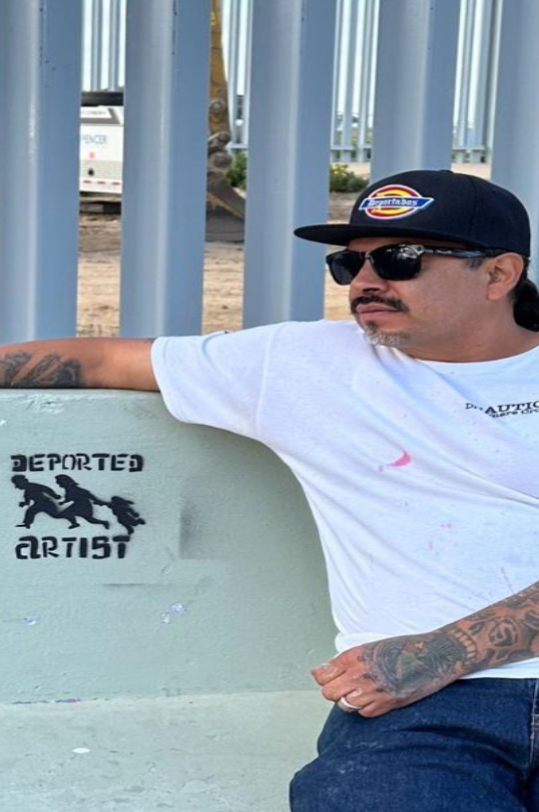
makes art to support his community
Following in the path of Wesly Désir, another Haitian migrant who even obtained his
doctoral degree in Tijuana and now works as an instructor at the UABC (Désir tells his own
story under the title “A Different Perspective on Haitian Migration”, Part I and Part II), Dales
decided not to limit himself to a single degree. In the third installment to his story, Dales
recounts his experience of learning a new language, English, in order to continue with his
studies, being admitted to a masters program in international law in the University of San Diego.
In addition, he speaks of plans for an internship with a organization in the US, where he will
work with migrants who need legal support regarding asylum, Temporary Protected Status or
other issues. At the end of the second part of his digital story, Dales offers inspiration for other
migrants also going through a difficult journey and who don’t want to abandon their personal
ambitions: “What one individual can accomplish, another can also accomplish.”
In contrast with Dales, who chose to stay on the border, there are other migrants who
have found themselves stuck at the border, though only temporarily. This does not mean that
they have not been able to contribute in sometimes extraordinary ways within these transitional
surroundings. Douglas Oveido, a Honduran migrant, in “ Stories from the Caravan: Part IV ”
about the difficulties he and his companions experienced upon arriving at the border in a
caravan in late 2018: “All the shelters were completely full [...] I saw people sleeping on the
street, mothers returning from court with nowhere to go.” Douglas, a charismatic and
entrepreneurial migrant, led a group of migrant activists who, with the help of people allied with
their cause in Tijuana, rehabilitated an abandoned building to create a shelter called Casa
Hogar el Puente, in his words: “a shelter for Central Americans, for migrants, made by us” so
that “migrants could feel at home, supported and safe.”
Extraordinary stories like these make clear not only how migrants are able to overcome
adversities, but also how these efforts refute false narratives and exaggerations that stigmatize
them. At the end of the day, these migrants are not victims or parasites, but leaders who can be
found on what Esther Morales calls in the fourth part of her story “the side of the brave.”
